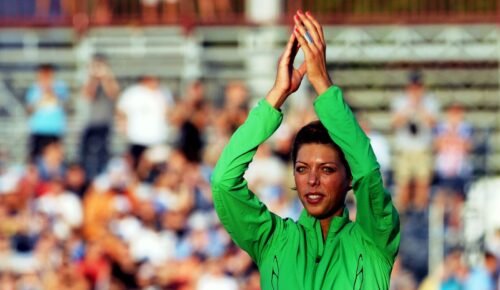
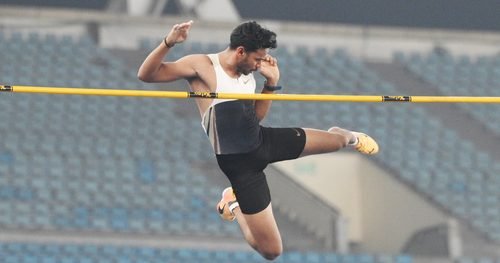
Javier Sotomayor won silver in high jump at 2000 Sydney Olympic Games. Since than no male Cuban high jumper has won Olympic medal.

Navneet Singh
Individual brilliance coupled with ample government support enabled Cuba’s Javier Sotomayor conquer the high jump arena, setting world record twice within a span of five years in early 1990s.
Sotomayor’s world record of 2.45m set in Spanish city of Salamanca in 1993 still stands testimony of his potential.
The 58 years old world record holder won his second Olympic Games medal, a silver in high jump at 2000 Sydney Olympic Games. Since Sydney Olympic Games, no male Cuban high jumper has won an Olympic medal, hinting it was sheer individual brilliance, and not a structured programme, that made Sotomayor achieve incredible feats.
Tokyo Olympic Games
Cuba’s Luis Zayas finished 26th in qualification (2.17m) at the Tokyo Olympic Games while he finished 14th (2.24m) in qualification at the 2024 Paris Olympic Games held in France.
“Winning global medal is all about talent and hard work,” Sotomayor told Sportsbackstory.com on the sidelines of recently-held Ekamra Sports Literature Festival here in New Delhi.
On Cuba’s not so encouraging performance in track and field at the 2024 Paris Olympic Games, Sotomayor said, it is like any other nation not winning medals at the Olympic Games.
Good facilities
“The new generation of Cuban athletes don’t get the kind of facilities available back in late 1980s and 1990s,” Cuban legend said through an interpreter.
“Cuban athletes sometimes don’t get USA visa for training and competition.”
Cuba’s 58 years old world record holder and two-time Olympic Games medallist in men’s high jump—twice improved the world record between 1989 and 1993.
He cleared 2.44m, a world record in 1989. Five years later he raised the bar to 2.45m to improve his world record at a Spanish city of Salamanca.
At the Barcelona Games in 1992 he won gold and eight years later at the 2000 Sydney Games he won silver. “I twice got the opportunity to compete at the Olympic Games. On both occasions I grabbed the chance with both hands,” recalls the world record holder.
Olympic Games
The celebrated Cuban high jumper says winning laurels at the global sporting events, particularly Olympics, was considered heroic in Cuba and he didn’t miss the opportunity that came his way. Missing back-to-back Olympic Games in 1984 and 1988 due to the Eastern Bloc boycotting the games still hurts Sotomayor. Cuba was associated with the Eastern Bloc. “I was in the best of my form during that period,” the Cuban Olympic champion in high jump claims. “I was sure to add medals to my cupboard from the Los Angeles Games in 1984 and Seoul Olympic Games in 1988.”
If the Olympic Games were close to Sotomayor’s heart, so was the Spanish city of Salamanca. Sotomayor has Spain’s citizenship too. He is known as El Principe de Las Alturas in Spanish (The Prince of Heights).
For the record, the 2024 Paris Olympic high jump champion Hamish Keer of New Zealand’s best jump was 2.36m in France.
Qatar’s star high jumper, Mutaz Barshim, came close to erasing Sotomayor’s name from record books but couldn’t go beyond 2.43m, a personal best and second-best jump in the history of track and field.
Basketball to athletics
Born in the late 1960s the world came to know about Sotomayor’s exceptional talent in high jump when he was just 16 years old. The towering six feet four inches was scouted for basketball but later switched to athletics. According to Sotomayor, talent alone can’t make an individual champion. There has to be hard work. “I enjoyed physical activities,” he reveals of his passion for sports.
He won his first Olympic medal, a gold at 1992 Barcelona Olympic Games. Eight years later he won his second, a silver at the Sydney Olympic Games. He missed the 1996 Atlanta Games due to knee injury.
Visualisation was one of the key factors to be successful, he says. “I used to set goals. Then I used to visualise it. It enabled me to achieve in actual competitions,” Sotomayor explains his success story.
Perfect jump
The Cuban athletics legend believes high jump is the most difficult track and field discipline. In an event like javelin the best throw can fetch a medal, he says.
“But in high jump even a perfect attempt might not earn a podium finish. That’s the difference between a perfect and winning jump.” Sotomayor explains.
Sotomayor says he had a typical style of take-off. The last stride was longer before the take off and wasn’t approved by the experts. “I was comfortable with the take off and had to explain to the coaches that it was ok with me,” he adds.
He also believes that modern day athletes are distracted by social media. “During my time I wasn’t able to contact my family for several days due to lack of communication facilities,” he adds. “Calling from the hotel was very costly when I was an active athlete. But these days athletes are often busy with mobile phones, which is sort of a distraction.”
ENDS