Sindhu goes down in a tough match against World No. 2 Wang Zhi Yi, but the other singles players and doubles combination fail to capitalise on their chances.
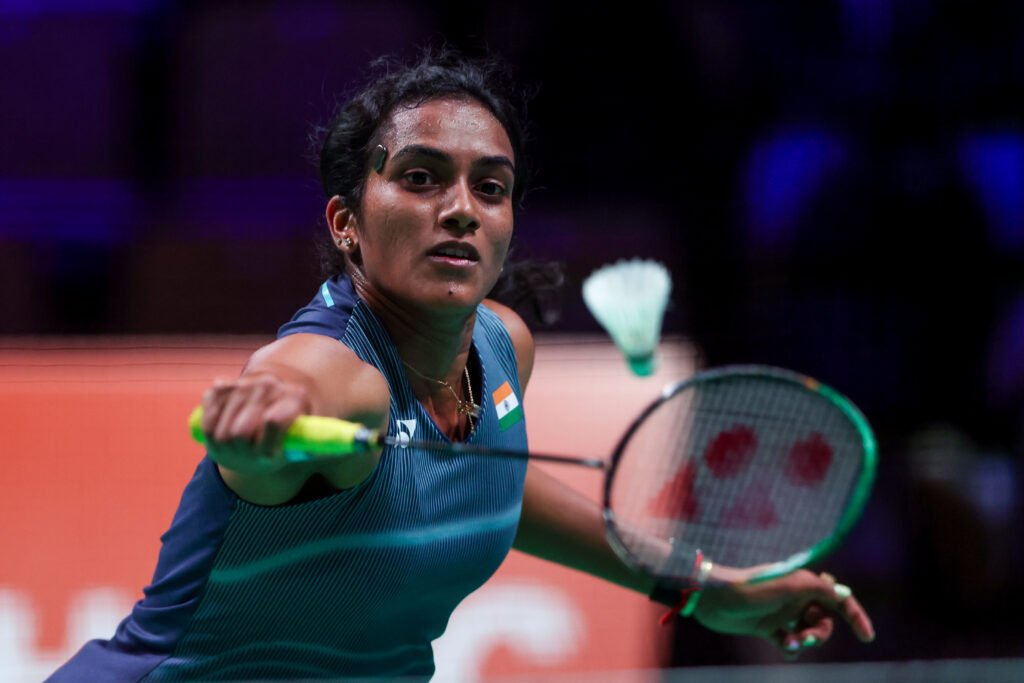
Two-time Olympics medallist PV Sindhu in action. Photo Credit: Badminton Photo
Our Correspondent
New Delhi: The Indian women’s team failed to capitalise on their chances as they went down 0-5 against defending champions China in their last Group A clash of the Thomas and Uber Cup.
Two-time Olympic medallist PV Sindhu fought a brave battle against World No. 2 Wang Zhi Yi but lost 16-21, 21-19, 19-21 in 78 minutes. Sindhu had a decisive lead of 18-12 against Wang in the third game, but the Chinese bounced back with seven consecutive points to turn the match in her favour.
In the other singles matches, Isharani Baruah lost to former Olympic champion Chen Yu Fei 20-22, 13-21, while Devika Sihag went down 21-19, 17-21, 10-21 against Xu Wen Jing. Both had their chances but could not make the most of them.
India’s scratch women’s doubles combination of Tanisha Crasto and Kavipriya Selvam raised hopes against Luo Xu Min and Zhang Shu Xian but ended on the losing side with a 10-21, 21-12, 21-19 scoreline.
India’s campaign thus came to an end, having lost their first group tie against Denmark 2-3. Their only win came (5-0) against Ukraine.
It has been a struggle for the Indian women’s team in recent times. While Sindhu is still battling it out, the other players have simply not been able to raise their level. Against Denmark too, Unnati Hooda and Tanvi Sharma failed to make their opportunities count.
Performance a concern, says Vimal Kumar
The performance of the women’s team is a concern, says former international and coach U Vimal Kumar.
“India’s loss to Denmark tells the same story. Unnati Hooda and Tanvi Sharma had their chances and didn’t take them. At the highest level, you either convert or you exit. Isha Rani had Chen Yufei on the ropes and let her off. At 20–19, a missed sitter. At this level, that’s the match,” Vimal said.
“The concern is deeper. Repeatedly leaving shuttles that are landing well inside the baseline and basic errors at the net—it’s not bad luck, it’s poor judgement under pressure. And it’s becoming a pattern,” said the Dronacharya Awardee coach.
—–