
International Weightlifting Federation changed a similar rule a decade ago. ‘Win on the mat, not on the scale.’
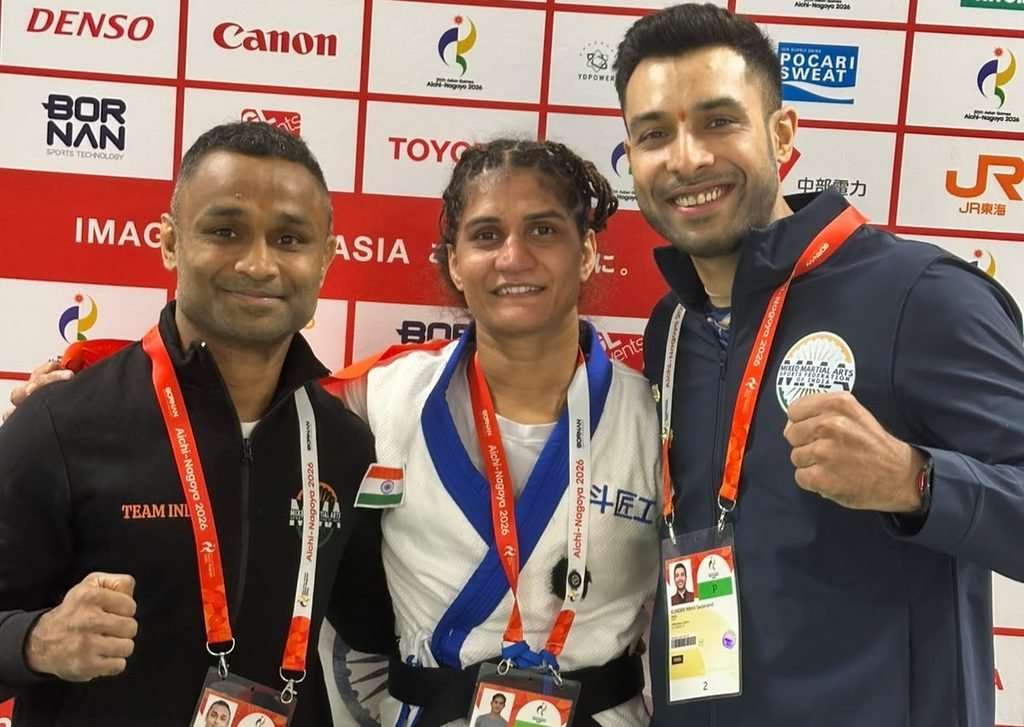
Mixed Martial Arts was one of the six disciplines that made its debut at the 20th Asian Games in Japan. However, the Asian MMA rules applicable during the Aichi-Nagoya Games saw India’s Suchika Tariyal lose a controversial semi-final against Singapore’s Hui Hoon Teo and settle for bronze in the women’s traditional 60kg category.
Suchika’s close fight with Hui Hoon Teo ended in a draw after regulation time. As per Asian MMA rules, an extra round of one minute was played out and the bout was awarded to Hui Hoon Teo. Suchika and the Indian camp challenged the decision, following which the Arbitration Commission upheld the appeal and changed the result to a draw.
It was then that the light-weight rule was applied, according to which the lighter of the two fighters was awarded the bout. The Singapore fighter (58.5kg) was just 700g lighter than Suchika (59.2kg) and was therefore handed the match. The decision did not go down well with the 36-year-old Suchika from Rohtak in Haryana. She broke down on the mat. However, her bronze medal was India’s first in mixed martial arts at the Asian Games.
However, the controversial tie-breaker rule is getting eyeballs. Cutting weight prior to competition is a big issue in combat sports. India’s multiple international medallist and Olympian Vinesh Phogat was overweight during the 50kg weigh-in before the final at the 2024 Paris Olympic Games and was consequently ruled out of the gold medal bout. She was disqualified.
But Suchika’s was not a case of being overweight. She was eligible to compete for her weight class, which was then considered for the tie-break. Some international federations have done away with such tie-break rules because they can force athletes to drastically cut their weight in case a match goes to a tie-break. Such weight cuts are harmful to athletes.
The International Weightlifting Federation used to have a similar tie-breaker rule 10 years ago but changed it a decade ago.
Earlier, if there was a tie, the lightest lifter (the one whose body weight was lower) would win. “This method was based on simple logic: For the same weight on the bar, the heaviest athlete has some advantage, so the lightest one should be favoured,” according to the IWF.
In 2016, the IWF decided to change this rule and adopt a new procedure. From 2017 onwards, in case of a tie, the athlete who first lifted or achieved the cumulative result would win. This rule already existed, but only as a second method to break a tie.
According to the IWF, the enforcement of the principle ensures athletes must win on the platform “and not in the sauna.”
The Asian Mixed Martial Arts Association (AMMA), founded in September 2022, is based in Singapore.
EOM