Flourishing club culture and strict guidelines to prevent abuse of the budding players are amongst two key features of a grassroots development programme in Australia, says Indian gymnastics coach in Melbourne.
Navneet Singh
Flourishing club culture and strict guidelines to prevent abuse of the budding players are amongst two key features of grassroots development programmes in Australia, says Tejadeep Chintakrindi, assistant gymnastics coach at Melbourne’s Dolphin Gymnastics training centre from Down Under. Tejadeep from Telangana is a qualified World Gymnastics Level 2 coach. He fulfilled Dolphin Gymnastics training centre coaching criteria and was invited to join the coaching department by Nadal Al Yousef, founder and former national coach of the Australian gymnastics team. Yousef had set up Dolphin Gymnastics centre in 1992.
Integrity of coach
Tejadeep, India’s former national champion in men’s gymnastics, has been coaching in Melbourne for the past four years. To join the coaching system in Australia, according to the Indian gymnastics expert, it’s mandatory to have a coaching licence, which is also verified by the police department to check the integrity of the coach. “It’s mandatory to have ‘Working With Children Check’ ID issued by Government of Victoria for all coaches overseeing training of players below the age of 18 years,” Tejadeep told Sportsbackstory.com over the phone from Melbourne. “The background of the coach is also verified by the Police Department. Any adverse report by the police can deny an individual coaching licence.”
Coaching licence
Coaching licence is important to work with a club, or any institution in Australia, says Tejadeep. “Any complaint of child abuse against the coach can result in coaching licence being invalid,” reveals the Indian coach. “It is hard to get the coaching licence once it’s cancelled. Without a valid licence an individual can’t work as a coach.”
Club culture
There are more than 150 gymnastics clubs spread across Melbourne, says Tejadeep. “Club culture gives players a chance to compete and learn at the grassroots level. And there are roughly 10-15 annual competitions in our region for youngsters,” he added.
Insurance of players
“To encourage sports activities, the government also gives financial support to players. The players are granted $200 (gymnastics) to pay the club training fee which ranges between $700 to $ 800 for three months. The remaining amount is paid by the respective parents,” claims Tejadeep. “The players are also insured and in case of an injury to an individual the Gymnastics Australia provides medical assistance.”
Training pattern
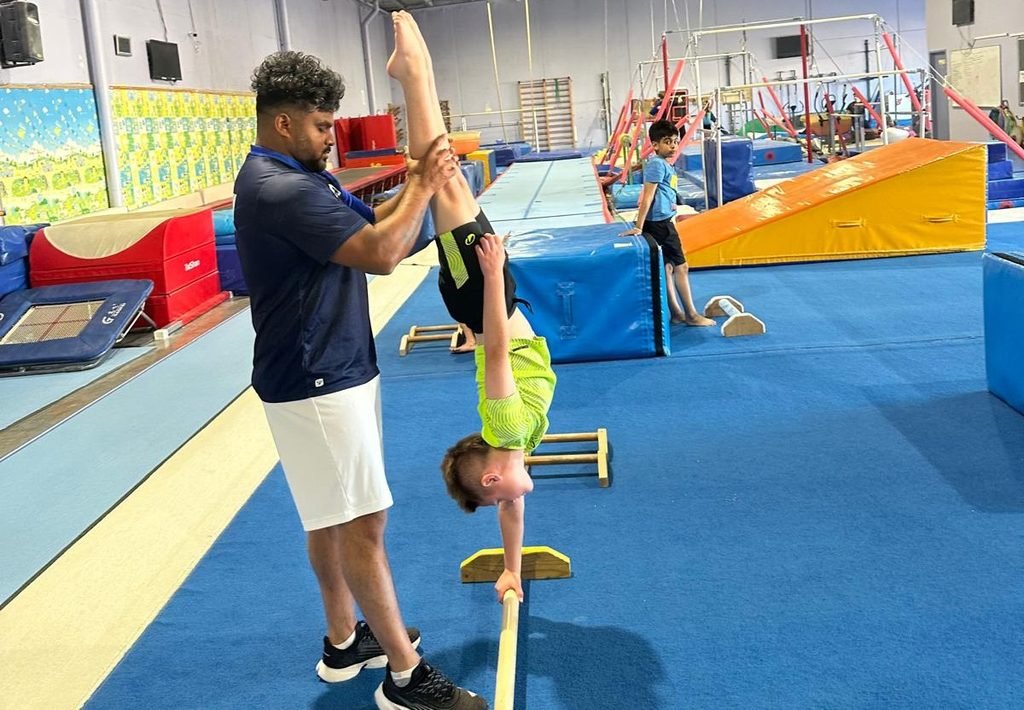
Hand stand, cartwheel, back flip, handspring and forward roll are some of the fundamentals of a training programme for beginners. “Proper technique is important to graduate to the next level,” said the Indian gymnastics coach.
The coaching system is subdivided into Level 3 to 10. While Level 3 is for beginners, Level 6 to 10 is for the elite category. “The Level 1 and 2 are for toddlers,” Tejadeep added. “Level 3 is for eight years and above. The group is relatively for those who want to learn the fundamentals of gymnastics.
Small group
Tejadeep oversees the Level 3 group of five boys. The age group is 8 to 10 years. There is one session a day for Level 3 players, he told Sportsbackstory.com. “If the number of players are more than five in a group, an additional coach/assistant is provided to oversee the practice session. A helper is given to assist in training. That’s the guidelines of the state governing body—Gymnastics Victoria and all the clubs follow it,” he said.
The Indian coach has also trained two players of Level 10 group. One of them went on to win bronze at the national (Australia) gymnastics competition.
Training assessment
The year is divided into four quarters and after each quarter (three months) there is an assessment of the gymnasts. “A report card is shared with the parents and players. Each individual is different and feedback is given to parents via email about the progress made by the players,” said Tejadeep.
EOM